
INTRODUCTION
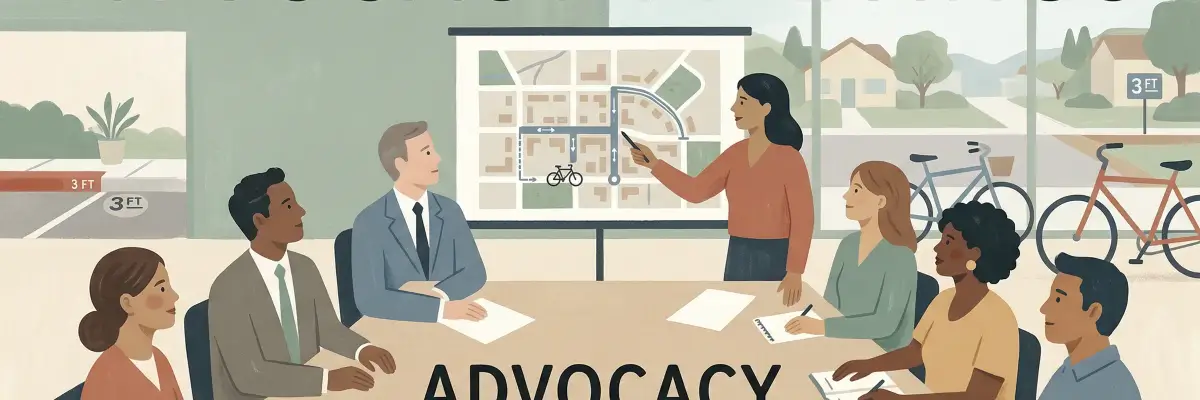
This guide is designed to help community organizations host effective advocacy meetings with city officials (Mayor, City Council members, transportation staff) focused on specific bicycle-related policy changes, infrastructure improvements, or safety issues. Rather than addressing cycling concerns generally, this approach emphasizes focusing each meeting on a single, well-defined policy request or geographic area to maximize impact and clarity.
Success in bicycle advocacy comes from being focused, prepared, and solution-oriented. Officials respond to specific, actionable requests backed by community support. {.is-success}
The Discussion Facilitation Guide and Conflict Resolution Strategies are additional helpful resources. {.is-info}
MEETING OVERVIEW
Format: 60-90 minute structured advocacy meeting
Setting: City hall, community center, or relevant neighborhood location connected to your issue
Participants:
- 10-30 concerned community members with diverse perspectives
- 3-5 core organizers/facilitators from your organization
- 2-7 city officials (council members, mayor, department heads, planners)
- 1-3 subject matter experts (optional)
Don't be discouraged by small numbers. A focused group of 15 well-prepared advocates can be more effective than 100 unfocused participants. {.is-info}
Purpose: To present a specific, actionable bicycle-related policy request to decision-makers, demonstrate community support, address concerns, and secure commitments to concrete next steps.
This meeting is designed to be:
- Focused: Addressing one specific policy, project, or geographic area
- Solutions-oriented: Offering clear, implementable proposals
- Evidence-based: Using data and community input to support requests
- Collaborative: Building relationships with officials while maintaining clarity about community needs
- Results-driven: Securing specific commitments and follow-up actions
CHOOSING YOUR FOCUS
Successful advocacy meetings target a specific issue rather than cycling concerns generally. Consider focusing on:
Policy Focus Examples
- Adopting a Complete Streets policy
- Implementing Vision Zero framework
- Updating street design standards
- Changing traffic enforcement priorities
- Revising development requirements for bicycle facilities
Geographic Focus Examples
- Safety improvements for a specific dangerous intersection
- Creating a protected bike lane on a specific corridor
- Implementing a neighborhood greenway or slow streets network
- Addressing school zone bicycle safety in a specific district
- Connecting specific gaps in the existing bicycle network
Programmatic Focus Examples
- Funding a bicycle education program in schools
- Establishing a bike share program
- Creating a bicycle-friendly business district program
- Implementing an Open Streets initiative
Choose issues that affect multiple stakeholders beyond just cyclists to build broader coalitions and demonstrate wider community benefit. {.is-warning}
DESIRED OUTCOMES
By the end of this meeting, you should achieve the following:
- Shared Understanding: Officials clearly understand the specific request and supporting rationale
- Documented Concerns: Both community and official concerns are acknowledged and recorded
- Commitment: Secure specific commitments to next steps with timeline
- Relationship Building: Strengthen working relationships between community advocates and officials
- Clear Accountability: Establish how progress will be monitored and reported
- Expanded Support: Engage new advocates and expand your coalition
PRE-MEETING PLANNING
3-6 Weeks Before
- Form a core planning team (3-5 people)
- Define your specific policy focus and desired outcome
- Research the issue thoroughly (current policies, best practices, etc.)
- Identify key decision-makers and their positions/concerns on the issue
- Reach out to officials to schedule the meeting
- Begin outreach to potential community participants
- Develop a one-page issue brief to share with officials in advance
1-2 Weeks Before
- Confirm meeting details with officials (date, time, location, format)
- Create a detailed agenda with time allocations
- Prepare your core presentation materials
- Assign specific roles to planning team members
- Hold a strategy session with key community participants
- Conduct additional outreach, especially to associated non-cyclists groups
- Gather relevant data, photos, maps, and supporting evidence
- Prepare a simple one-page handout summarizing your request
1-6 Days Before
- Send a reminder to officials with agenda and one-page brief
- Confirm final attendance from community members
- Rehearse presentations and personal testimonials
- Prepare sign-in sheets and materials
- Finalize visual aids and handouts
- Confirm logistics (room setup, AV needs, accessibility)
- Brief any subject matter experts or special participants
- Prepare media talking points
INVITING OFFICIALS
Which Officials to Invite
Be strategic about which officials you invite based on your specific goal:
For Policy Changes:
- Council members who sit on relevant committees (transportation, public safety)
- Department heads with implementation authority (transportation, planning)
- The mayor (if the issue is a priority for their administration)
For Infrastructure Projects:
- City planners or engineers responsible for the area
- Council members representing the area (if not at large) or relavent committee
- Department heads who control relevant budgets
For Enforcement or Behavioral Issues:
- Police department representatives
- Transportation or public safety officials
- Council members focused on public safety
Always invite officials who both support and may oppose your position. Converting skeptics is as important as mobilizing allies. {.is-info}
Making the Request
Your initial outreach should be clear, professional, and focused:
Sample Email Template:
Subject: Meeting Request: [Specific Policy/Project] Discussion with [Organization Name]
Dear [Official's Name],
[Organization Name] requests a meeting with you and your staff regarding [specific issue, e.g., "implementing protected bike lanes on Main Street" or "adopting a Complete Streets policy"]. As residents and community stakeholders, we've developed a proposal that addresses [brief description of need and solution].
We'd like to schedule a [60-90] minute meeting on [suggest 2-3 dates/times] to:
- Present our specific proposal
- Share community perspectives from diverse stakeholders
- Address questions and concerns
- Discuss potential implementation steps
Approximately [number] community members will attend, representing [briefly list relevant stakeholders: e.g., "local businesses, schools, neighborhood associations"].
Attached is a one-page overview of our proposal. We welcome the opportunity to work collaboratively with you on this important issue for our community.
Thank you for your consideration,
[Your Name] [Organization] [Contact Information]
PREPARING YOUR CASE
Core Components of Your Presentation
Expanded details for this section
Long section
Core Components of Your Presentation
Expanded details for this section
Core Components of Your Presentation
Your presentation to officials should include these key elements:
1. The Specific Request (5 minutes)
- Clearly state what policy, project, or change you're requesting
- Make it actionable and within the officials' authority
- Connect it to existing city goals, plans, or values
2. The Problem Statement (5-7 minutes)
- Define the specific problem being addressed
- Use local data, photos, and specific examples
- Demonstrate who is affected and how (beyond just cyclists)
3. Community Perspectives (10-15 minutes)
- Brief personal testimonials from diverse stakeholders
- Representation from different user groups, neighborhoods, backgrounds
- Business, school, health, equity, and environmental perspectives
4. The Proposed Solution (10 minutes)
- Details of your specific proposal
- Examples from other cities if applicable
- Alignment with existing city plans/policies
- Implementation options and timeline
5. Addressing Concerns (10 minutes)
- Proactively address likely objections
- Present data on common concerns (traffic flow, parking, cost)
- Show community support and benefits to multiple stakeholders
6. Clear Next Steps (5 minutes)
- Specific actions requested from officials
- Timeline for implementation or next phase
- How progress will be measured and reported
Compelling Data to Include
Expanded details for this section
Long section
Compelling Data to Include
Expanded details for this section
Compelling Data to Include
Effective bicycle advocacy requires strong supporting evidence:
Safety Data:
- Crash and injury statistics for the area in question
- Speed data and vehicle counts
- Near-miss reports or community safety surveys
Economic Data: Gathering local economic impact data can be tricky. Any information you can collect on the below (or even generalized national data) can significiantly help your case, especially with decision makers who want to agree, but need something to share with skeptics.
- Cost-benefit analysis compared to other transportation investments
- Impact of bicycle infrastructure on local businesses
- Property value changes near bicycle improvements
- Tourism or economic development potential
Transportation Data:
- Current and potential bicycle usage counts
- Mode share statistics for the area
- Traffic congestion impacts
- Parking utilization studies
Community Support:
- Petition signatures
- Survey results from diverse stakeholders
- Endorsements from businesses, institutions, or community groups
- Letters of support from unexpected allies
Present data visually whenever possible—maps showing crash locations, simple before/after photo visualizations, and infographics comparing options are particularly effective. {.is-success}
MEETING LOGISTICS
Setting Up for Success
Expanded details for this section
Long section
Setting Up for Success
Expanded details for this section
Setting Up for Success
The physical setup of your meeting can significantly impact its effectiveness:
Ideal Room Arrangement:
- U-shaped or circular seating if possible
- Community members and officials integrated, not opposing sides
- Presentation area visible to all
- Sign-in table at entrance
- Materials prepared and pre-distributed
Essential Materials:
- Sign-in sheet for all attendees
- Agenda for each participant
- One-page summary of proposal
- Supporting maps, photos, or visuals
- Name tags for key participants
- Recording method (notes, audio/visual if permitted)
Technology Needs:
- Projector and screen if using visual presentation
- Microphones for larger rooms
- Computer/tablets for displaying maps or data
- Recording equipment if appropriate and permitted
Accessibility Considerations:
- Childcare options when possible
- Meeting time that allows working people to attend
- Translation services if needed for your community
- Clear signage to meeting location
- Transportation options (including bicycle parking)
MEETING AGENDA TEMPLATE
90-Minute Meeting Format
| Time | Activity | Description |
|---|---|---|
| 0:00-0:10 | Welcome & Introductions | Meeting purpose, agenda overview, brief introductions |
| 0:10-0:15 | Problem Statement | Define the specific issue with supporting evidence |
| 0:15-0:30 | Community Perspectives | Brief testimonials from diverse stakeholders |
| 0:30-0:40 | Proposed Solution | Presentation of specific policy/project request |
| 0:40-0:55 | Official Response & Questions | Officials respond and ask clarifying questions |
| 0:55-1:10 | Discussion & Addressing Concerns | Collaborative discussion of potential challenges |
| 1:10-1:25 | Next Steps & Commitments | Specific actions, timeline, and accountability measures |
| 1:25-1:30 | Closing & Thanks | Appreciation, summary, follow-up plan |
Note: For smaller meetings or when time is limited, a 60-minute version can be created by reducing each segment by 25-30%.
FACILITATION TECHNIQUES
Opening the Meeting
Purpose: Set a collaborative tone while maintaining focus on your specific request
Facilitator Script: "Thank you all for making time to discuss [specific issue]. We're here today as residents who care deeply about making our streets safer and more accessible for everyone. Our specific focus is [state single, clear request].
We know you share our commitment to a city that works for all residents, and we appreciate the opportunity to discuss this particular proposal. Our goal today is to present our specific request, hear your perspective, address questions or concerns, and agree on concrete next steps.
Let's start with brief introductions around the room."
Managing Official Responses
Officials may try to broaden the discussion or deflect from your specific request. Use these techniques to maintain focus:
When an official broadens the topic:
- Acknowledge the related concern: "That's an important issue..."
- Redirect to your focus: "...and it connects to our specific request today, which is..."
- Suggest a separate discussion: "We'd be happy to schedule another conversation about that broader topic, but today we'd like to focus on..."
When an official seems dismissive:
- Validate with data: "We understand that concern, and here's what the data shows..."
- Share personal impact: "I'd like to ask [community member] to share how this issue affects them directly."
- Connect to city goals: "This proposal would help achieve the city's stated goal of..."
When an official cites obstacles:
- Acknowledge constraints: "We understand there are budget/staff/timeline considerations..."
- Offer phased approach: "We've outlined several implementation options, including a phased approach that could begin with..."
- Suggest collaborative problem-solving: "Could we work together to identify potential funding sources/implementation strategies?"
Securing Commitments
Purpose: End with clear next steps rather than vague support
Techniques:
- Be specific in your asks: "Would you commit to bringing this proposal to the Transportation Committee by the March meeting?"
- Get timeframes: "What is a realistic timeline for staff to complete this assessment?"
- Establish check-ins: "Could we schedule a follow-up meeting in six weeks to review progress?"
- Document commitments: "To confirm, you're committing to [specific action] by [specific date]. Is that correct?"
- Offer partnership: "Our organization can provide [specific resource or support] to help move this forward."
Sample Commitment Requests:
- "Will you introduce this policy at the next council meeting?"
- "Can your department complete a safety study of this intersection by next quarter?"
- "Would you commit to including this project in next year's capital budget?"
- "Can we get a written response to our proposal within 30 days?"
HANDLING CHALLENGING SITUATIONS
Common Challenges and Responses
Expanded details for this section
Long section
Common Challenges and Responses
Expanded details for this section
Common Challenges and Responses
Challenge: Officials Don't Show Up
- Document the absence and proceed with those who did attend
- Send a follow-up with meeting notes and a renewed request
- Use social media strategically (without alienating officials)
- Consider a public records request for relevant documents
Challenge: Officials Arrive Unprepared
- Provide a brief, clear summary of your pre-meeting materials
- Focus on your most essential points
- Offer to reschedule a follow-up with more preparation time
- Proceed with information-sharing rather than decision-making
Challenge: Topic Constantly Shifts
- Politely but firmly redirect: "To address your point about [tangential issue], we'd like to focus today on [specific request]"
- Use visual aids to keep the focus on your specific topic
- Have your facilitator actively manage the discussion
- Acknowledge broader issues for future meetings
Challenge: Technical Objections Dominate
- Bring subject matter experts to address technical concerns
- Ask for written technical concerns to address after the meeting
- Focus on the policy principle rather than technical details
- Suggest a technical working group as a next step
Challenge: No Clear Commitments Made
- Ask direct yes/no questions that require clear answers
- Restate vague commitments as specific actions
- Propose a written follow-up documenting what was agreed to
- Schedule a specific follow-up meeting date before leaving
POST-MEETING ACTIONS
Immediate Follow-up (Within 48 Hours)
- Send thank-you emails to officials who attended
- Distribute meeting notes to all participants
- Document any commitments made by officials
- Share outcomes with your broader membership/community
- Post appropriate updates on social media
- Follow up on any information promised during the meeting
Within Two Weeks
- Send a formal letter restating your request and any commitments
- Begin working on any community-side next steps promised
- Schedule check-in calls with official staff
- Gather any additional information requested
- Plan appropriate public communication strategy
- Thank community members who participated
Ongoing Accountability
Expanded details for this section
Long section
Ongoing Accountability
Expanded details for this section
Ongoing Accountability
- Track progress against committed timelines
- Schedule regular check-ins with official staff
- Prepare for relevant public meetings (council, committees)
- Update your membership and coalition partners
- Document progress and setbacks
- Plan escalation strategies if commitments aren't kept
SAMPLE FOLLOW-UP EMAIL
Subject: Thank You and Next Steps: [Specific Project/Policy] Meeting on [Date]
Dear [Official Name],
Thank you for meeting with [Organization Name] regarding [specific policy/project request]. We appreciate your time and thoughtful engagement with our proposal for [brief description].
Meeting Summary During our discussion, we covered: • The safety concerns at [location/policy gap] • Community perspectives from [briefly list stakeholder types] • Our specific proposal to [brief description] • Your questions regarding [summarize main questions/concerns]
Commitments Made We want to confirm the next steps agreed upon:
- Your office will [specific commitment] by [date]
- [Organization] will provide [any follow-up promised] by [date]
- A follow-up meeting will be scheduled for [timeframe]
Additional Information As requested, we're attaching [any promised documents/information]. We're also available to [offer of continued support/involvement].
We look forward to working together on this important project for our community. Please don't hesitate to contact me with any questions or updates.
Sincerely,
[Your Name] [Organization] [Contact Information]
MAINTAINING MOMENTUM
Between Meetings
Effective advocacy continues between official meetings:
Communication Strategies:
- Regular (but not excessive) check-in emails with staff
- Brief updates at public comment periods of relevant meetings
- Newsletter updates to your membership
- Strategic social media highlighting progress (or lack of progress)
- Letters to the editor or op-eds at key decision points
Coalition Building:
- Expand support to non-traditional allies
- Gather additional endorsements from businesses/organizations
- Hold informational events for potential supporters
- Connect with other advocacy groups on related issues
- Develop relationships with neighborhood associations
Documentation:
- Track all commitments and timelines
- Gather additional supporting data
- Document conditions with photos, videos, or community mapping
- Collect additional community testimony
- Monitor implementation of similar projects elsewhere
Presence at Related Meetings:
- Attend budget hearings
- Participate in transportation plan updates
- Monitor capital improvement planning meetings
- Attend neighborhood council meetings
- Observe transportation commission meetings
FOLLOW-UP MEETING AGENDA
If progress stalls or commitments aren't kept, a follow-up meeting may be necessary:
60-Minute Follow-Up Format
| Time | Activity | Description |
|---|---|---|
| 0:00-0:05 | Welcome & Purpose | Brief reminder of previous meeting and purpose today |
| 0:05-0:15 | Progress Review | Review of commitments made and status update |
| 0:15-0:25 | Addressing Obstacles | Discussion of challenges encountered |
| 0:25-0:40 | Modified Approach | Presentation of adjusted proposal if needed |
| 0:40-0:55 | Renewed Commitments | Clear articulation of next steps and timeline |
| 0:55-1:00 | Closing & Thanks | Appreciation and documentation plan |
TEMPLATES & RESOURCES
One-Page Issue Brief Template
To Do: Draft completed example letter(s) and link to word doc or Google Docs {.is-danger}
[CLEAR TITLE OF REQUEST] E.g., "Main Street Protected Bike Lane Proposal" or "Complete Streets Policy Adoption"
THE REQUEST: 1-2 sentence specific request to officials
THE PROBLEM: 3-4 bullet points with key statistics or examples
- [Specific safety data point]
- [Specific usage/demand data point]
- [Specific impact on community]
- [Connection to broader city goals]
THE SOLUTION: 3-4 bullet points describing your proposal
- [Key element of solution]
- [Implementation approach]
- [Timeline consideration]
- [Cost consideration or funding source]
COMMUNITY SUPPORT: Brief list of supporting organizations, petitions, surveys
- [Number of petition signatures]
- [Key organizations/businesses]
- [Survey results if available]
BENEFITS: 4-5 bullet points highlighting benefits beyond cycling
- [Safety benefit]
- [Economic benefit]
- [Health/environmental benefit]
- [Equity/accessibility benefit]
- [Alignment with city plans/goals]
CONTACT: [Name, Organization, Phone, Email]
Sign-in Sheet Template
Expanded details for this section
Long section
Sign-in Sheet Template
Expanded details for this section
Sign-in Sheet Template
To Do: Create word doc or Google Doc with link for easy printing / editing {.is-danger}
[Meeting Title] - [Date]
Your information helps us follow up with updates on this issue. We will not share your information outside our organization without permission.
| Name | Phone | Address/Neighborhood | I can help with: (circle) Testimony / Data Collection / Outreach / Other | |
|---|---|---|---|---|
FINAL THOUGHTS
Effective bicycle advocacy with city officials requires focus, preparation, and persistence. By narrowing your request to a specific policy, project, or geographic area, you make it easier for officials to understand, respond to, and ultimately implement your proposals.
Remember these principles of effective advocacy:
- Be specific: Officials can't act on general concerns, but they can respond to concrete proposals
- Be solution-oriented: Come with proposals, not just problems
- Be prepared: Data, community support, and clear materials demonstrate seriousness
- Be strategic: Understand decision-making processes and key stakeholders
- Be persistent: Follow up consistently without becoming adversarial
- Be collaborative: Find common ground with officials when possible
- Be inclusive: Demonstrate how your proposal benefits the broader community
Change happens through focused, strategic efforts backed by organized community support. By following this approach, your advocacy will be more effective in creating safer, more accessible bicycle infrastructure and policies in your community.